

The digital world is experiencing a seismic shift as AI-powered answer engines rapidly redefine what it means to be visible online. As aeo seo emerges, businesses and marketers face a new frontier where direct, concise answers often replace traditional lists of links.
This article dives deep into the battle between aeo seo and traditional SEO, aiming to predict which strategy will lead in 2026. You will discover clear definitions, key differences, and how evolving search habits are influencing the future of optimization.
Expect actionable strategies, industry trends, and practical use cases to help you adapt. Ready to future-proof your digital approach? Let’s explore which SEO approach will secure your success in the evolving search landscape.
Understanding AEO SEO and Traditional SEO
The digital landscape is rapidly evolving, and understanding the difference between aeo seo and traditional SEO is crucial for future success. Both approaches shape how brands are discovered online, but their methods, goals, and outcomes are increasingly distinct as we move toward 2026.
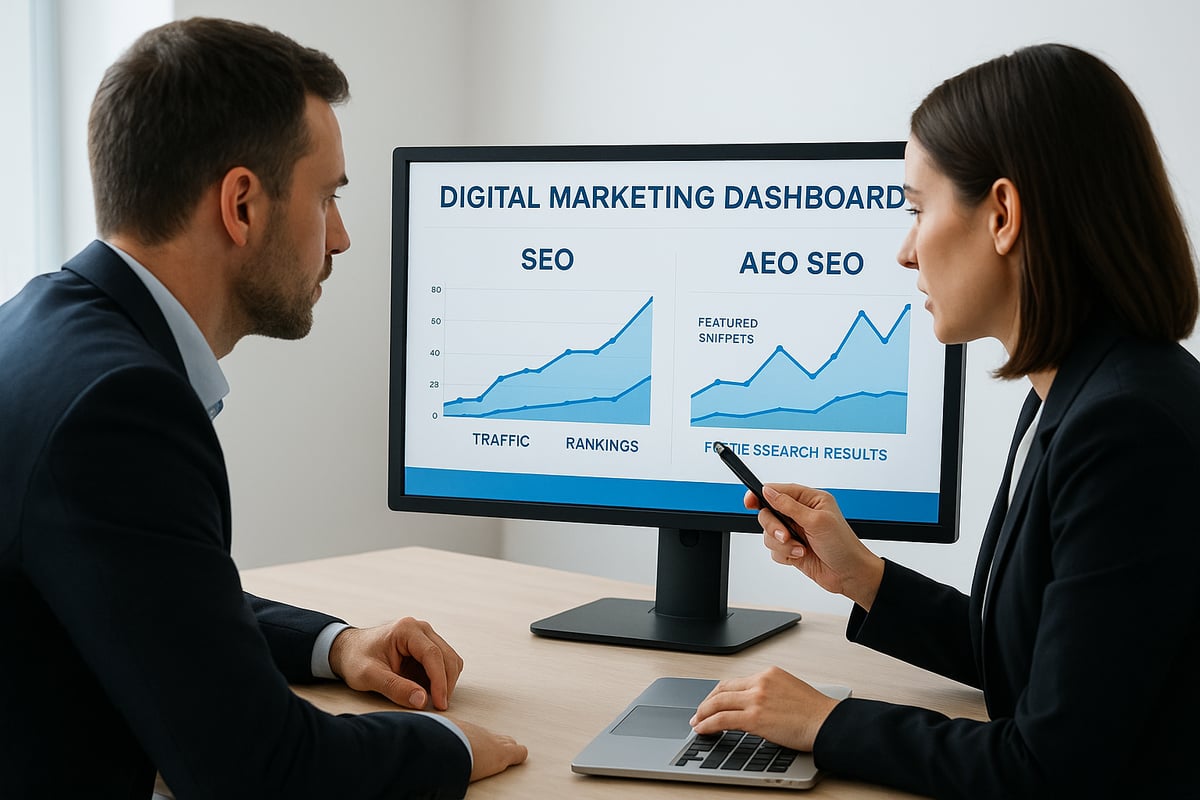
What is AEO SEO?
AEO SEO, or Answer Engine Optimization, is the process of tailoring content specifically for AI-powered platforms like ChatGPT, Perplexity, and Gemini. The main goal of aeo seo is to provide clear, direct answers to user questions in conversational and voice-based searches.
This approach relies on structured data, FAQs, schema markup, and concise summaries to optimize for AI-driven engines. For example, content designed for featured snippets or AI overviews directly supports aeo seo goals. According to recent data, there are over a billion voice searches every month, and AI engines are quickly becoming primary sources for information retrieval.
The benefits of aeo seo include increased brand authority, higher visibility in zero-click environments, and future-proofing digital presence as AI-driven search grows. For a deeper dive into its principles, see the Answer engine optimization overview.
What is Traditional SEO?
Traditional SEO focuses on optimizing web content to rank higher in organic search results on engines like Google and Bing. The purpose of traditional SEO is to drive traffic, generate leads, and increase conversions through keyword-rich, long-form content.
Common tactics include publishing blog posts, creating landing pages, building backlinks, and optimizing metadata. Since the 1990s, traditional SEO has been the backbone of digital marketing, capturing more than 40 percent of online revenue.
The advantages of traditional SEO are its broad reach, established best practices, and ability to support robust conversion funnels. While it remains a cornerstone for many businesses, the rise of aeo seo is beginning to reshape the competitive landscape.
How Search Behaviors Are Changing in 2026
In 2026, user search behaviors are shifting from text-based queries toward voice and conversational interactions. AI engines now deliver instant, summarized answers, which has led to zero-click searches accounting for over 65 percent of Google queries.
Users expect direct answers instead of lists of links, and mobile plus AI assistant usage is surging. This trend means brands must rethink their approach, ensuring they are visible not just on search engines but also within AI-driven platforms where aeo seo excels.
The implications are clear: to stay relevant, brands need to optimize for where users are searching, not just rely on traditional SEO tactics.
Why This Comparison Matters Now
The rise of AI and answer engines is transforming the search market, making the comparison between aeo seo and traditional SEO more important than ever. Businesses that depend solely on traditional SEO risk losing visibility as AI-powered platforms gain market share.
Combining both strategies maximizes reach and authority, helping brands adapt to changing user expectations. Ultimately, the balance between aeo seo and traditional SEO will determine digital marketing ROI and competitive advantage in 2026.
Key Differences Between AEO SEO and Traditional SEO
The evolution of search is accelerating, and understanding the key differences between aeo seo and traditional SEO is essential for staying ahead. As search platforms diversify, businesses must adapt their optimization strategies to capture visibility wherever users seek answers. Let’s break down the distinctions that define these two approaches.
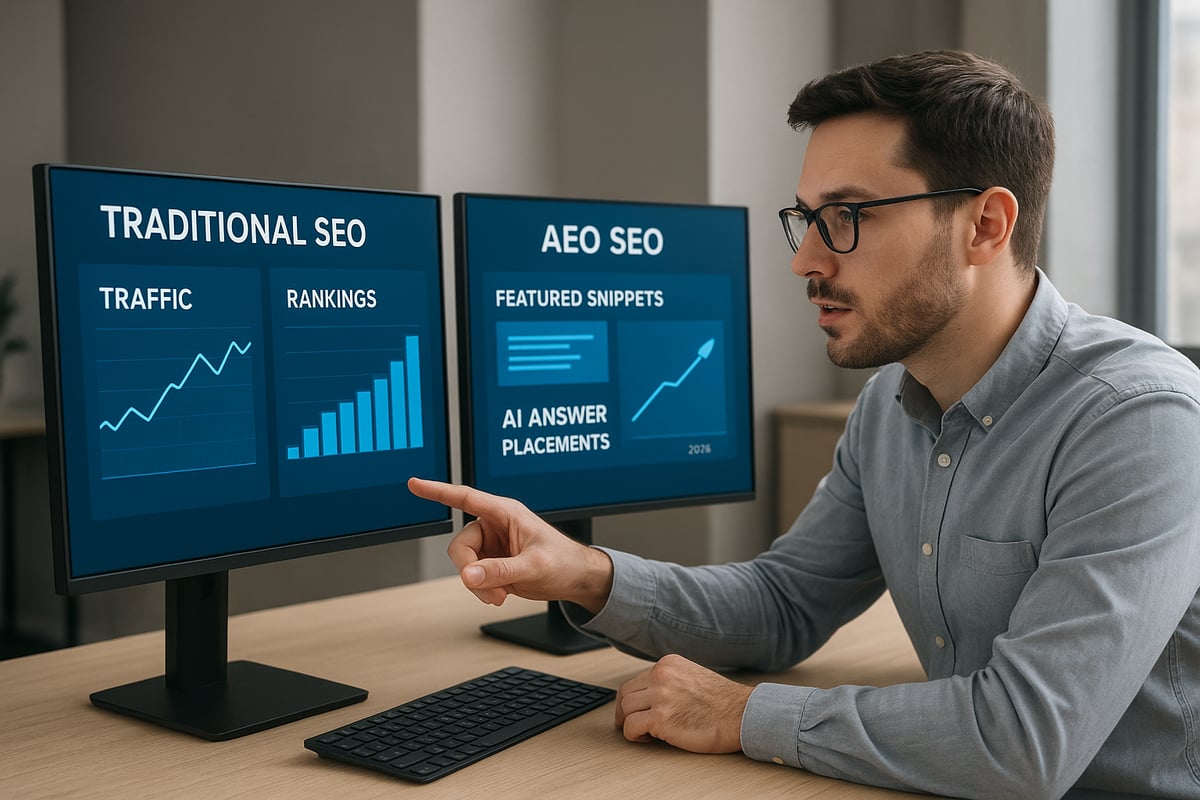
Core Goals and Objectives
At the heart of aeo seo lies the goal of providing users with immediate, precise answers through AI-driven engines and voice assistants. This approach is designed to meet the needs of conversational and context-aware searches, ensuring that content is selected as the authoritative response in AI-generated overviews.
Traditional SEO, on the other hand, is centered around improving organic rankings and driving website traffic by targeting specific keywords. The objective is to move users through a conversion funnel, from discovery to action, using long-form content and established ranking factors.
To summarize:
| AEO SEO | Traditional SEO | |
|---|---|---|
| Goal | Direct, instant answers | Traffic, ranking, conversions |
| Focus | User experience, authority | Visibility, engagement |
Aeo seo prioritizes user intent and quick solutions, while traditional SEO aims for sustained traffic and broader reach.
Optimization Methods and Techniques
Optimization tactics diverge significantly between aeo seo and traditional SEO. Traditional SEO relies heavily on keyword research, backlink acquisition, and technical site improvements. These methods have been refined over decades to align with Google’s ranking algorithms.
Aeo seo introduces new layers, like structured data and schema markup, which help AI engines interpret and surface content as direct answers. Concise Q&A sections, FAQ blocks, and alignment with AI language models are also essential.
For a deeper look at traditional SEO’s evolving tactics, see Traditional SEO strategies in 2026.
Aeo seo borrows foundational practices from SEO but tailors optimization for AI and voice search, ensuring content is machine-readable and contextually relevant.
Content Formats and Structure
Content structure is another area where aeo seo and traditional SEO diverge. Traditional SEO favors long-form articles, comprehensive guides, and pillar pages that address a wide range of related topics. These formats are designed to capture multiple keywords and serve users at different stages of their journey.
Aeo seo, however, focuses on short, structured answers, FAQs, lists, and tables. This approach aligns with the needs of AI engines, which prefer bite-sized, well-defined information for quick extraction and display.
For example, an FAQ page optimized for aeo seo is more likely to be featured in voice search results or AI-generated overviews, while a deep-dive blog post may rank well in traditional search listings.
User Targeting and Search Intent
User targeting strategies also reflect the shift between aeo seo and traditional SEO. Traditional SEO is geared toward broad, research-driven, and transactional queries, often optimized for both desktop and mobile devices.
Aeo seo hones in on conversational, context-based, and voice-activated queries. Content is crafted to address specific questions users might ask AI assistants or smart speakers.
Consider these examples:
- “Best Italian restaurant near me” (aeo seo, optimized for local and conversational search)
- “Italian restaurant reviews” (traditional SEO, optimized for research-based queries)
Aeo seo ensures brands are present wherever users seek instant answers, not just in classic search results.
Performance Metrics and Success Indicators
Measuring success varies greatly between aeo seo and traditional SEO. Traditional SEO tracks organic traffic, keyword rankings, click-through rates, and conversions. These metrics reflect the goal of driving users to a website.
Aeo seo, in contrast, focuses on visibility in AI overviews, featured snippets, voice search results, and zero-click engagements. As over 65 percent of Google queries now result in zero-click searches, being selected as the authoritative answer is increasingly valuable.
Performance is assessed by answer box placements and presence in AI-generated responses, not just website visits. Aeo seo requires new analytics approaches to capture these outcomes, emphasizing the importance of adapting measurement strategies for the AI era.
How to Optimize for AEO SEO and Traditional SEO in 2026
Optimizing for aeo seo and traditional SEO in 2026 requires a holistic, agile approach. As search evolves, brands must blend proven SEO fundamentals with advanced answer engine optimization to maximize visibility across both search engines and AI-driven platforms.
Building a Future-Proof SEO Foundation
To thrive in the evolving landscape, businesses must anchor their strategy in strong fundamentals. Start with robust on-page and technical SEO. This means ensuring your site is mobile-friendly, loads quickly, and offers secure browsing. These elements remain nonnegotiable for both aeo seo and traditional SEO.
Continue investing in strategic keyword research. Identify evergreen topics and new trends that align with your audience’s needs. Regularly update content to keep it relevant, and maintain a clean, well-structured website architecture.
By merging these essentials with aeo seo tactics, you create a foundation that stands the test of time. This approach ensures your brand remains visible regardless of how search technology changes.
Structuring Content for AI Engines and Traditional Search
Content structure is now more important than ever. For aeo seo, prioritize clear Q&A sections, concise summaries, and well-labeled lists or tables. These formats help AI engines quickly extract and present your answers in voice searches and AI overviews.
At the same time, maintain comprehensive, in-depth content for traditional SEO. Use pillar pages, detailed guides, and strategic internal linking to signal authority. Implement schema markup to help both search engines and AI platforms interpret your content accurately.
Here is a quick comparison table:
| Strategy | AEO SEO Focus | Traditional SEO Focus |
|---|---|---|
| Content Structure | Short Q&A, FAQs | Long-form, Pillar Pages |
| Markup | Schema, FAQ, HowTo | Title, Meta, H1 |
Balancing these approaches ensures your content serves both human and AI audiences, securing your spot in the answer-driven future.
Leveraging Data and User Intent
Success in 2026 hinges on understanding and predicting what users want. Use AI-powered tools to analyze semantic relationships and anticipate emerging questions. For aeo seo, identify conversational queries and optimize content to deliver direct, relevant answers.
Map your content to both broad and specific intents. For traditional SEO, target high-value keywords with in-depth articles. For aeo seo, create targeted FAQ sections and concise summaries.
Explore AI optimization hacks for SEO to uncover actionable strategies that boost your content’s performance on both traditional and AI-driven platforms. This dual focus ensures your digital presence is both broad and deep, capturing users wherever they search.
Integrating Schema Markup and Structured Data
Schema markup is a cornerstone of effective aeo seo. By adding structured data like FAQ, HowTo, and Product schemas, you help AI engines and search platforms understand your content’s context and value. This increases your chance of being featured in answer boxes, voice search results, and AI overviews.
For traditional SEO, structured data also enhances rich snippets in the SERP, improving click-through rates and visibility. Regularly audit your markup to ensure it is accurate and up to date.
Combining schema markup with strong content makes your site a trusted source, ready to meet the needs of both traditional and AI-driven searchers.
Adapting to Voice and Conversational Search
Voice and conversational queries are transforming the search landscape. To win in aeo seo, optimize for natural language, using a conversational tone and question-based keywords. Focus on long-tail queries that reflect how people speak, not just how they type.
Examples include creating content that answers “How do I optimize my website for AI search?” or “What is the best strategy for aeo seo in 2026?” Use FAQ blocks and direct answers to improve your chances of being selected by voice assistants.
By aligning your strategy with the way users interact with AI platforms, you stay ahead of evolving search habits and maintain your competitive edge.
Next Engine Optimization (NEO): Bridging Traditional SEO and AEO for 2026 Success
NEO represents the future of search by unifying traditional SEO, aeo seo, and Generative Engine Optimization (GEO). This integrated model ensures your content is visible across Google, ChatGPT, Claude, Perplexity, and similar platforms.
With NEO, multi-platform optimization is seamless. Businesses can capture traffic from both classic search engines and emerging AI-driven answers. AI-powered retargeting further expands your reach, re-engaging potential customers wherever they are active.
NEO’s transparent, flat-rate pricing and no-contract model make advanced optimization accessible for SMBs. Embracing this unified approach future-proofs your digital visibility and positions your brand for sustained growth in the 2026 search ecosystem.
Industry Trends and the Future of Search in 2026
The digital search landscape is undergoing rapid transformation, with aeo seo strategies at the forefront of this evolution. As artificial intelligence reshapes how we access information, brands must adapt to new platforms, behaviors, and technologies to remain competitive in 2026.

The Rise of AI-Driven Search Engines
AI-powered platforms such as Perplexity, ChatGPT, Claude, and Gemini are rapidly gaining user adoption. These engines deliver direct, conversational answers, shifting focus away from traditional link lists. Google’s AI overviews and Microsoft Copilot have further accelerated this trend, integrating aeo seo into mainstream search habits.
According to Gartner predicts 25% drop in search engine volume by 2026, the rise of AI chatbots and virtual agents is expected to reduce search engine usage significantly. This shift means businesses optimizing for aeo seo will be more visible across emerging platforms.
Zero-Click Searches and the Decline of Traditional SERP Traffic
The increase in zero-click searches is one of the most impactful trends shaping aeo seo. Over 65% of Google queries now result in an answer delivered directly on the search page, eliminating the need for users to click through to websites.
Answer boxes, featured snippets, and AI-generated summaries are now prime digital real estate. As a result, traditional SEO traffic is declining, and aeo seo strategies are essential for maintaining online visibility. Businesses that adapt their content for these new formats are better positioned to capture attention in zero-click environments.
Machine Learning, Personalization, and Predictive SEO
Advancements in machine learning are fueling hyper-personalization within search experiences. AI algorithms analyze user behavior and context to provide tailored answers, making aeo seo more dynamic and user-centric than ever.
Predictive SEO tools help marketers anticipate emerging queries and trends, allowing proactive content creation. Google’s RankBrain and similar technologies prioritize intent over keywords, which means aeo seo must focus on delivering concise, authoritative answers that align with evolving user needs.
The Blurring Line Between AEO and SEO
The distinction between aeo seo and traditional SEO is becoming less defined as both strategies converge. Successful brands now integrate structured, concise answers within comprehensive long-form content to satisfy both AI engines and classic search platforms.
For example, an article may include detailed guides (for SEO) alongside schema-marked FAQ sections (for aeo seo). This hybrid approach ensures maximum discoverability and adaptability across all digital touchpoints.
Challenges and Opportunities for Businesses
Adapting to these industry trends presents both hurdles and advantages. Organizations must continually educate teams and update processes to keep pace with rapid change. Failing to embrace aeo seo could result in lost visibility and declining market share.
On the other hand, early adopters of aeo seo and AI-focused optimization can secure first-mover advantage. Integrating both strategies positions brands for sustainable growth, resilience, and leadership in the dynamic 2026 search landscape.
Practical Use Cases: When to Prioritize AEO, SEO, or Both
Understanding when to focus on aeo seo, traditional SEO, or a combination of both is crucial for digital success in 2026. Each business type and marketing goal presents unique challenges and opportunities. Let’s explore how different industries and strategies benefit from these optimization methods.
E-Commerce and Local Businesses
For e-commerce brands and local businesses, aeo seo is increasingly essential. Consumers use AI assistants and voice search to find “best pizza near me” or “buy running shoes online.” These conversational queries are often answered directly by AI engines, making concise, schema-rich content vital.
- Local discovery is driven by zero-click answers and AI recommendations.
- Product and location-based queries benefit from structured data and FAQ sections.
- Businesses adopting aeo seo early gain visibility in voice and AI search results.
Recent data shows a surge in AI adoption, yet most users still rely on search engines for purchase decisions. According to AI tool adoption jumps to 38%, but 95% still rely on search engines, integrating both strategies ensures maximum reach for e-commerce and local brands.
B2B and Content Marketing
In the B2B sector, long-form, research-driven content remains the backbone of traditional SEO. However, aeo seo supports authority-building by surfacing expert answers in AI-generated summaries and featured snippets.
- Whitepapers, case studies, and guides drive organic traffic and leads.
- Executive summaries and FAQ blocks deliver quick answers for AI engines.
- Combining both methods positions brands as trusted sources across platforms.
B2B marketers should map content to both transactional and conversational intents. By blending aeo seo with classic SEO, businesses capture audiences at every stage of the buyer journey.
Service Providers and Professionals
Service providers, such as lawyers, doctors, and consultants, benefit from aeo seo through direct answers and schema optimization. FAQs and knowledge bases help these professionals surface in AI-powered answer engines and traditional search alike.
- Schema markup highlights credentials, services, and contact information.
- Concise, well-structured responses address common client questions.
- Aeo seo increases authority in zero-click and voice search environments.
At the same time, detailed service pages and blog content bolster traditional SEO rankings. Balancing both ensures professionals are discoverable through any search channel.
Multi-Platform Brands and Agencies
Brands and agencies operating across multiple channels need a unified approach. Integrating aeo seo with traditional methods maximizes digital footprint and adapts to evolving user behavior.
- Holistic strategies optimize content for search engines and AI platforms.
- Agencies offer clients solutions that span Google, Bing, and emerging AI engines.
- Early adopters of Google vs. AI search engines strategies outperform competitors by meeting users wherever they search.
In 2026, aeo seo is not just a supplement but a necessity for brands aiming to lead in both organic and AI-driven discovery.
FAQs: AEO SEO Versus Traditional SEO in 2026
As search evolves, businesses have critical questions about aeo seo versus traditional SEO. Let’s address the most common concerns, providing clarity for your 2026 strategy.
Can AEO and SEO Work Together?
Absolutely, aeo seo and traditional SEO are not mutually exclusive. In fact, integrating both yields the best results. Use SEO’s keyword research and content depth to establish authority, while leveraging aeo seo tactics to capture featured snippets, voice results, and AI-driven answers.
For example, a long-form guide optimized for SEO can include structured FAQ sections and schema markup to enhance aeo seo visibility. The rise of Generative Engine Optimization highlights this convergence, showing how future-ready strategies merge both approaches to maximize reach across traditional and AI-powered platforms.
Is AEO Replacing Traditional SEO?
Aeo seo is not replacing traditional SEO, but rather building upon its foundation. While traditional SEO remains vital for organic rankings and traffic, aeo seo addresses new user behaviors like conversational and voice search.
Both are essential as search engines and AI platforms coexist. For instance, Google still drives significant traffic, but AI engines like ChatGPT and Gemini are increasingly influential. Adopting a dual approach ensures your brand is visible wherever users search. Keeping pace with search innovation is key to staying competitive in 2026.
What Content Types Work Best for AEO?
Certain content formats excel in aeo seo environments. FAQs, concise Q&A sections, lists, tables, and schema-marked summaries are highly effective. These structures help AI engines quickly identify and extract direct answers for users.
For example, a well-organized FAQ page or a summary table increases the likelihood of being featured in answer boxes and AI overviews. Using structured data and clear formatting is essential for maximizing aeo seo results. Strive for brevity and clarity in all content aimed at AI-driven platforms.
How Do I Measure Success in AEO Versus SEO?
Measuring success differs between aeo seo and traditional SEO. For SEO, track rankings, organic traffic, click-through rates, and conversions. For aeo seo, focus on featured snippet placements, AI engine referrals, and zero-click visibility.
Use analytics tools that capture both types of metrics. Monitor how often your content appears in answer boxes, voice search results, and AI summaries. Comparing these insights helps refine your approach and ensures optimal performance across both traditional and AI-driven channels.
What’s the Cost Difference Between AEO and Traditional SEO Services?
Traditional SEO services typically cost $2,000 to $5,000 per month and often require long-term contracts. In contrast, aeo seo and integrated solutions frequently offer flat fees and greater flexibility, making them attractive for small and mid-sized businesses.
As AI-driven search platforms expand, ad spending is projected to surge, reflecting the value of aeo seo strategies. According to Reuters, AI-driven search ad spending may reach $26 billion by 2029, underscoring the financial impact and industry shift toward AI optimization.
As we’ve explored, the future of search is more dynamic than ever—balancing the strengths of traditional SEO with the rising influence of AI-driven answer engines. If you’re wondering how to adapt your digital strategy so your business stands out across both Google and emerging AI platforms, you’re not alone. Let’s talk about actionable ways to future proof your online presence, integrate AEO and SEO, and ensure you’re ready for whatever 2026 brings. Ready to take the next step or have specific questions about your brand’s visibility? Book a call and let’s navigate these changes together.