

Imagine getting instant, accurate answers and real-time insights, all within a single chat window. With chatgpt search, finding information in 2026 feels effortless and intuitive.
This guide will show you how chatgpt search is changing the way we discover knowledge, blending the power of conversational AI with up-to-date web results. Whether you are a curious learner or a business professional, mastering these tools will keep you ahead as search evolves.
We will explore how chatgpt search works, its key features, practical steps for effective searching, optimization tips, and future trends. Ready to unlock smarter, faster, and more personalized search? Let us get started.
The Evolution of Search: From Keywords to Conversational AI
Imagine searching for answers online just a few years ago. You typed a string of keywords, scanned through ads and blue links, and hoped to find what you needed. Today, chatgpt search is redefining this experience. Instead of sifting through clutter, users now engage in natural conversations, receiving intuitive, context-aware responses. This evolution is reshaping not just how we search, but also what we expect from technology.

The Shift from Traditional to AI-Powered Search
Search engines have come a long way, moving from rigid keyword matching to understanding natural language and user intent. With chatgpt search, the process becomes more like a conversation than a transaction.
For example, when you search for "best running shoes 2026" on Google, you get a long list of links, ads, and summaries. But chatgpt search delivers a tailored recommendation, considering your preferences and context. This shift means users expect more dialogue, nuance, and real-time understanding.
A recent Adobe survey found that 77% of U.S. chatgpt search users now rely on it as their primary search engine. This trend is only accelerating as conversational AI becomes the new norm.
Why People are Switching to ChatGPT Search
Many users grew frustrated with traditional search engines due to intrusive ads, spammy results, and declining quality. Chatgpt search addresses these pain points by providing real-time, ad-free, and context-aware answers.
Trust in chatgpt search is also rising. According to surveys, 30% of U.S. respondents trust chatgpt search more than legacy engines. Younger demographics, especially Gen Z, are leading this migration, with 28% choosing chatgpt search first.
Imagine discovering new brands or products seamlessly within a chat conversation. The experience feels more personal and less transactional, which is why chatgpt search is quickly becoming the preferred gateway to information.
AI Search Engines in the Competitive Landscape
The landscape of AI search is rapidly evolving. Chatgpt search stands alongside Google Gemini, Microsoft Copilot, Perplexity, and Claude, each competing to deliver smarter, more helpful results.
A major differentiator is chatgpt search's integration of real-time data, media partnerships, and transparent citations. Users can access up-to-date weather, stocks, and news, all with direct source links for deeper research. For a detailed look at how these platforms compare, see Google vs AI Search Engines.
When you ask for the latest headlines, chatgpt search presents a concise list with clickable links, making research more efficient and transparent than ever.
The Role of AI in Shaping Search Intent and Discovery
AI is now central to understanding user context, intent, and preferences. Chatgpt search maintains context across multiple queries, enabling users to ask follow-up questions and receive personalized recommendations.
In fact, 36% of chatgpt search users report discovering new products or topics during multi-turn conversations. For instance, after getting a restaurant suggestion, you can immediately ask for similar options or dietary accommodations, and chatgpt search adapts in real time.
This approach means chatgpt search is not just about providing answers, but about guiding users through their information journey, making discovery smarter and more intuitive.
Inside ChatGPT Search: Features, Interface, and Capabilities
Experience the next evolution of online discovery with chatgpt search. In 2026, chatgpt search redefines how users interact with the web, blending advanced conversational AI with real-time data for a seamless, intuitive search journey. Here is a deep dive into its features, user interface, and the capabilities that set it apart.
How ChatGPT Search Works in 2026
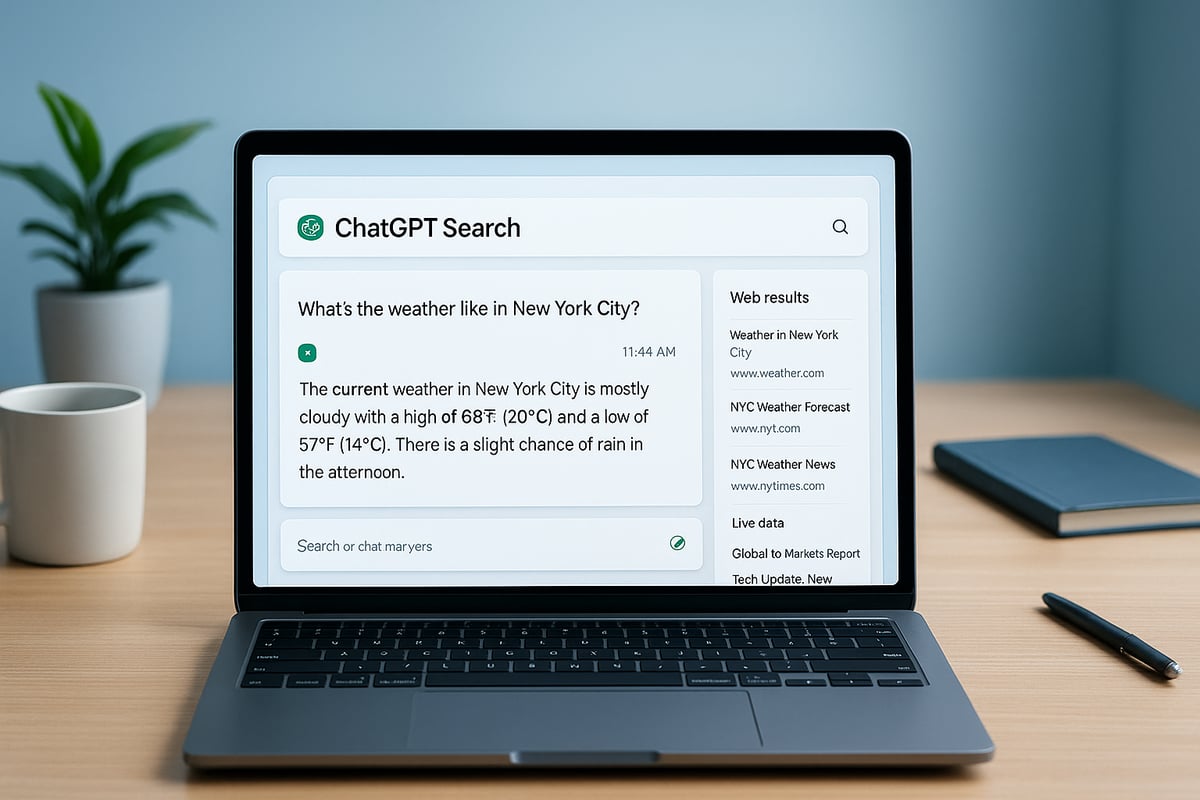
Chatgpt search is now fully integrated within the ChatGPT interface, offering users a unified space for both conversation and live web results. You can activate web search manually with a dedicated icon, or let chatgpt search detect when your query needs up-to-date information.
Whether you need breaking news, live sports scores, or the latest financial data, chatgpt search pulls real-time information directly into your chat. For example, a simple question about current weather will prompt instant, location-specific updates. This capability bridges the gap between static AI models and the dynamic, ever-changing landscape of the internet.
Key Features and Functionalities
Chatgpt search stands out for its conversational approach to delivering search results, complete with embedded web citations and clickable source links. Key features include:
- Conversational answers with transparent citations
- Sidebar displaying sources in a familiar search results layout
- Headline and link previews for in-depth exploration
- Integrations with media partners for up-to-the-minute data on stocks, weather, and more
Suppose you ask for recent news on electric vehicles. Chatgpt search will provide a summary, a list of headlines, and direct links so you can dive deeper into the original stories. This format ensures every answer is both informative and easy to verify.
User Experience: Interface and Accessibility
The chatgpt search experience is designed for ease of use. The intuitive search bar lets you type or speak natural language prompts, while the interface seamlessly transitions between chat and search modes.
Currently, chatgpt search is available to Plus, Team, Enterprise, Edu, and pilot users, with plans underway to expand support to Advanced Voice Mode and eventually free accounts. Accessibility is a top priority, with features like mobile-friendly layouts and robust voice search options. For example, you can switch from typing to voice input without losing context or functionality.
Transparency, Trust, and Source Attribution
Transparency is a cornerstone of chatgpt search. Every factual claim is backed by a clickable citation in the sidebar, allowing users to verify information instantly. This approach directly addresses concerns about misinformation and builds trust with users.
When you ask for statistics or breaking news, chatgpt search lists sources alongside its responses, making it clear where the information comes from. By providing source attribution and direct links, chatgpt search distinguishes itself from opaque AI assistants and traditional search engines that often obscure their data origins.
Limitations and Current Challenges
Despite its strengths, chatgpt search still faces some limitations. Older AI models may have a knowledge cutoff, potentially missing events or developments after 2023. As of early 2026, full access to chatgpt search remains limited to certain user tiers.
Critical thinking is essential, as not all sources surfaced by chatgpt search carry equal reliability. When handling ambiguous or sensitive topics, the system may present multiple perspectives but leaves final judgment to the user. Chatgpt search is powerful, but it works best when users combine its insights with careful evaluation of the sources provided.
Step-by-Step Guide: Mastering ChatGPT Search for Everyday Use
Unlock the full potential of chatgpt search with this hands-on guide. Whether you are new to conversational AI or aiming to streamline your daily tasks, these steps will help you get the most from chatgpt search in 2026. Let us walk through setup, smarter querying, result navigation, advanced techniques, and privacy essentials so you can master this AI-powered tool with confidence.

Getting Started with ChatGPT Search
Begin your journey by accessing chatgpt search through ChatGPT Plus, Team, Enterprise, Edu, or as a pilot tester. After signing in, look for the web search icon in the interface—usually beside the prompt bar. Click to activate it, granting permissions if prompted.
Your first use might involve a short walkthrough. Pay attention to any pop-ups explaining features. To confirm chatgpt search is enabled, check for the search toggle or a note in your account settings.
- Sign up or log in to ChatGPT.
- Locate the search feature icon.
- Activate search and review permissions.
A simple example: ask, "What are the top news headlines today?" and watch chatgpt search deliver real-time, cited results. If you do not see the search option, your account may not have access yet—check the latest updates from OpenAI.
Crafting Effective Prompts for Better Results
The quality of your chatgpt search results depends on your queries. Use natural language, as if speaking to an assistant. Be clear and specific—add context, timeframes, or preferences.
Try prompts like:
- "Find recent studies on remote work trends in 2026."
- "Show me reviews for electric cars released this year."
Add details to refine results. For example, "Compare the best noise-canceling headphones under $200 in 2026." The more context you provide, the better chatgpt search can serve your needs.
Tips for better prompts:
- Use full sentences.
- Specify what, when, or where.
- Include desired formats (lists, summaries, comparisons).
Navigating Results, Citations, and Source Links
Chatgpt search responses are conversational, but packed with information. Look for embedded sources and clickable citations—these verify facts and let you explore deeper.
You will often see:
- Source links in-line with answers.
- A sidebar with a list of all referenced websites.
- Headline previews for quick scanning.
For example, if you ask for "data on global e-commerce growth," chatgpt search might summarize key stats and provide a citation. Click the link to read the original report. Always verify information by cross-checking multiple sources, especially for important decisions.
Using ChatGPT Search for Research, Shopping, and Productivity
Chatgpt search is a versatile tool for daily life. Use it to summarize articles, compare products, or find statistics fast. Planning a trip? Ask for real-time weather updates, travel advisories, and top attractions—all in one conversation.
For shopping, request product comparisons, reviews, and price trends. For research, summarize long papers or extract key points from news stories. Boost productivity by generating meeting summaries, checking facts, or scheduling events.
Example workflow:
- "Plan a 3-day visit to Tokyo in April. What is the weather and must-see spots?"
- "Summarize the latest trends in AI-powered marketing."
Chatgpt search streamlines your workflow, saving time and effort.
Advanced Techniques: Follow-Up Queries and Multi-Turn Conversations
A standout feature of chatgpt search is its ability to maintain context. After your initial question, ask follow-ups for deeper insights. For instance, start with "Best laptops for students in 2026," then continue with "Now compare those under $1,000."
This multi-turn approach mimics expert research assistants, allowing you to:
- Refine or narrow results step by step.
- Ask clarifying questions without repeating context.
- Explore tangential topics as they arise.
Leverage chatgpt search to guide your information journey, not just answer isolated queries.
Privacy, Security, and Account Management
Understanding privacy is crucial with chatgpt search. The tool accesses real-time web data and may store search history depending on your settings. Manage your privacy by reviewing account options: you can delete or export search data, and adjust data-sharing preferences.
- Regularly clear your search history.
- Review OpenAI’s privacy policy for transparency.
- Update permissions as needed.
Your data security is a priority, but always use chatgpt search with awareness. Stay informed about any policy changes to maintain control over your information.
Optimizing for AI Search: Visibility, Content, and Business Opportunities
As chatgpt search becomes a primary gateway for discovering information in 2026, optimizing for AI-driven engines is now mission-critical for businesses and content creators. Unlike traditional SEO, AI search optimization focuses on how conversational models interpret, summarize, and surface content in real time. Ignoring chatgpt search means missing out on a rapidly growing audience that expects instant, context-rich answers.
Why AI Search Optimization Matters in 2026
The rise of chatgpt search has transformed how users discover brands, products, and information. With nearly half of marketers now leveraging chatgpt search for promotion, and two-thirds planning to increase their AI focus, the importance of visibility in these channels is clear. Small businesses, in particular, are gaining traction as chatgpt search recommends their offerings directly in conversational results, often bypassing ad-saturated traditional engines.
For organizations, this shift means adapting strategies to reach audiences where they are searching today. Optimizing for chatgpt search is no longer optional, but essential for maintaining relevance and capturing new market share.
Content Strategies for ChatGPT and AI Engines
Success in chatgpt search starts with creating content that AI can understand and recommend. Focus on comprehensive, context-rich writing that answers user questions conversationally. Use schema markup to structure data, making it easier for chatgpt search to parse FAQs, guides, and product details.
Update your content regularly to ensure it reflects the latest trends and data, as chatgpt search prioritizes fresh, authoritative information. Formats like lists, how-tos, and in-depth guides perform especially well. Consider adding a FAQ section with clear, concise answers, which AI engines frequently surface in results.
Technical Optimization: AEO and GEO Fundamentals
Technical optimization is the backbone of visibility in chatgpt search. AI Engine Optimization (AEO) and Generative Engine Optimization (GEO) ensure that your site is not only crawlable but also interpretable by AI models. Use semantic HTML, structured data like JSON-LD, and clearly labeled answer boxes to support chatgpt search in extracting relevant information.
AEO focuses on chatbot recommendations, ensuring your content is positioned as a trusted answer. GEO, meanwhile, targets generative engines, optimizing for inclusion in AI-generated summaries and responses. Both approaches are vital for maximizing your presence in chatgpt search results.
Next Engine Optimization (NEO): Future-Proofing Your Business for AI Search
Next Engine Optimization (NEO) takes a holistic approach, blending SEO, AEO, and GEO to guarantee discoverability across both traditional and AI-powered search engines. By integrating multi-platform strategies, NEO positions your business for visibility on Google, chatgpt search, Claude, Perplexity, and more.
With transparent pricing and AI-powered retargeting, NEO enables businesses to adapt as users migrate from legacy platforms to chatgpt search. Companies leveraging NEO are consistently ahead of the curve, capturing audiences as search behavior evolves.
Measuring Success: Analytics and AI Search Performance
Measuring performance in chatgpt search requires new tools and metrics. Track AI-driven traffic, engagement, and brand mentions across chatgpt search and other AI engines. Monitor citations and source links to understand where your content is being referenced.
Combine traditional analytics with AI-specific insights for a comprehensive view. Use this data to refine your content and technical strategies, ensuring ongoing visibility as chatgpt search continues to reshape the digital landscape.
The Future of AI-Powered Search: Trends and Predictions for 2026 and Beyond
Imagine a world where chatgpt search responds instantly to your voice, analyzes images, and tailors results to your needs. The next wave of AI-powered search is quickly approaching, redefining how we interact with information, brands, and technology. Here is what to expect as we look toward 2026 and beyond.
The Rise of Multi-Modal and Voice Search
Multi-modal chatgpt search is transforming how users access information. In 2026, search is not limited to typing queries. You can ask a question aloud, upload a photo, or even point your device at an object for instant results. ChatGPT’s Advanced Voice Mode and image recognition features enable frictionless, natural interactions across smartphones, desktops, and smart home devices.
For example, searching for “best hiking trails near me” can now include voice instructions, map previews, and real-time weather updates. This seamless integration of text, voice, images, and video is making chatgpt search more accessible and intuitive than ever before.
Personalization, Privacy, and Ethical AI
Personalization is a core advantage of chatgpt search in the future. AI engines will analyze your preferences, search history, and context to deliver results that are unique to you. Imagine receiving restaurant recommendations based on your past reviews or curated news feeds tailored to your interests.
However, this level of personalization brings privacy and ethical considerations to the forefront. Opt-in settings, transparent data policies, and explainable AI are becoming standard. As chatgpt search evolves, ethical guidelines and privacy protections will be essential to building user trust and maintaining transparency.
The Impact on Marketing, E-Commerce, and Everyday Life
The rapid adoption of chatgpt search is reshaping marketing and e-commerce. Businesses are optimizing for conversational discovery, making it easier for users to find new products and brands through AI-driven recommendations. In fact, ChatGPT’s 800 Million Weekly Users in 2025 shows the scale of this shift, with millions relying on chatgpt search every week for product research and daily tasks.
Marketers are now focusing on creating content that is both conversational and structured for AI. For users, this means effortless comparison shopping, instant access to reviews, and smarter decision-making in everyday life.
Challenges and Opportunities Ahead
Despite its promise, chatgpt search faces ongoing challenges. Misinformation, source reliability, and AI bias remain critical concerns. Users must remain vigilant, verifying facts and using multiple sources. At the same time, opportunities for innovation are everywhere: smarter agents, real-time learning, and deeper integrations are on the horizon.
Human oversight will continue to play a vital role, ensuring that chatgpt search remains accurate, fair, and trustworthy. As the landscape evolves rapidly, those who adapt will be best positioned to thrive in the new era of AI-powered search.
FAQ: ChatGPT Search and AI-Powered Search Engines
Curious about chatgpt search and how it fits into the evolving world of AI-powered search engines? Below, we answer the most common questions to help you get started, assess its reliability, and optimize your content or business for this new era.
What is ChatGPT Search and how does it work?
Chatgpt search is an advanced AI-powered search tool that combines conversational language models with real-time web access. Unlike traditional search engines, chatgpt search allows you to ask questions in natural language and receive direct, context-rich answers that include citations and links to original sources.
For example, you can ask for the latest research on renewable energy, and chatgpt search will provide a summary with clickable references. It bridges the gap between static AI models and dynamic web content, making information discovery more intuitive and interactive.
Is ChatGPT Search free to use?
Currently, chatgpt search is available to ChatGPT Plus, Team, Enterprise, Edu, and select pilot testers. Free access is not yet fully rolled out, but OpenAI has announced plans to expand availability in the future. To check if your account supports chatgpt search, look for the web search icon within the ChatGPT interface or refer to your subscription details.
First-time users may need to enable permissions for web access. If you’re interested in trying chatgpt search, consider signing up for a Plus or Team plan, or keep an eye out for upcoming updates on broader access.
How accurate and reliable are ChatGPT Search results?
Chatgpt search is designed for transparency and trust. Each response includes source citations, allowing users to verify information directly. The AI pulls from reputable, up-to-date web sources, but users should still apply critical thinking, as not all sources are equally reliable.
Knowledge cutoffs may affect older AI models, and results can vary depending on query complexity. Always review the provided links and compare multiple sources when using chatgpt search for research or decision-making.
How can businesses optimize for ChatGPT and AI search engines?
To increase visibility in chatgpt search, businesses should focus on creating comprehensive, conversational, and structured content. Implementing schema markup and updating FAQs can help AI engines understand and surface your content.
For actionable strategies, explore ChatGPT SEO Optimization Strategies, which details best practices for ranking in AI-powered search. Staying updated with optimization trends ensures your business remains discoverable as chatgpt search becomes a primary search tool for consumers.
As we’ve explored together, mastering AI-powered search with tools like ChatGPT is no longer just an advantage—it’s essential for staying ahead in 2026. Whether you want your business to be found across Google, ChatGPT, and tomorrow’s AI engines, or you’re ready to optimize your content for this new era, you don’t have to navigate it alone. If you’re curious about tailoring your strategy to maximize visibility and growth, let’s connect.
Book a call and discover how you can position your brand at the forefront of the evolving search landscape.